Key takeaway
Improve the path from discovery to first useful action. More installs help only when the app delivers what brought people there.
An install is a beginning. Someone has seen enough value to give your app space on their phone, but they have not yet discovered whether it deserves a place in their routine. A download campaign that ignores this second decision can produce a busy chart and a quiet product.
To increase app downloads responsibly, look at the whole journey. That means the message that creates interest, the store page that earns the install, and the first experience that turns curiosity into use. Fixing a weak connection between these steps can be more useful than adding another acquisition channel.
01Define the first useful action
Write down what a new user should accomplish before they can judge the app fairly. For a budgeting tool, it might be creating a first budget. For a language app, it could be completing a lesson. Registration alone usually tells you less about value than an action connected to the product's purpose.
Instrument that action with appropriate analytics and privacy controls. Agree what you will count as an activated user, then use the same definition across campaigns. Without a shared definition, one team may celebrate downloads while another is trying to understand why nobody returns.
02Find the weakest step before buying more traffic
Break the journey into discovery, store visit, install, first useful action, and return. Use the information available in your store consoles and product analytics to see where people stop. Attribution will not be perfect, but a broad view of the journey is still more informative than an install total alone.
Few store visits may point to a message or distribution problem. Many visits with few installs suggest that the page, offer, or audience needs attention. Plenty of installs with little activity call for an onboarding review. Each pattern requires a different response; buying more traffic is not the answer to all three.
03Make the store page continue the campaign
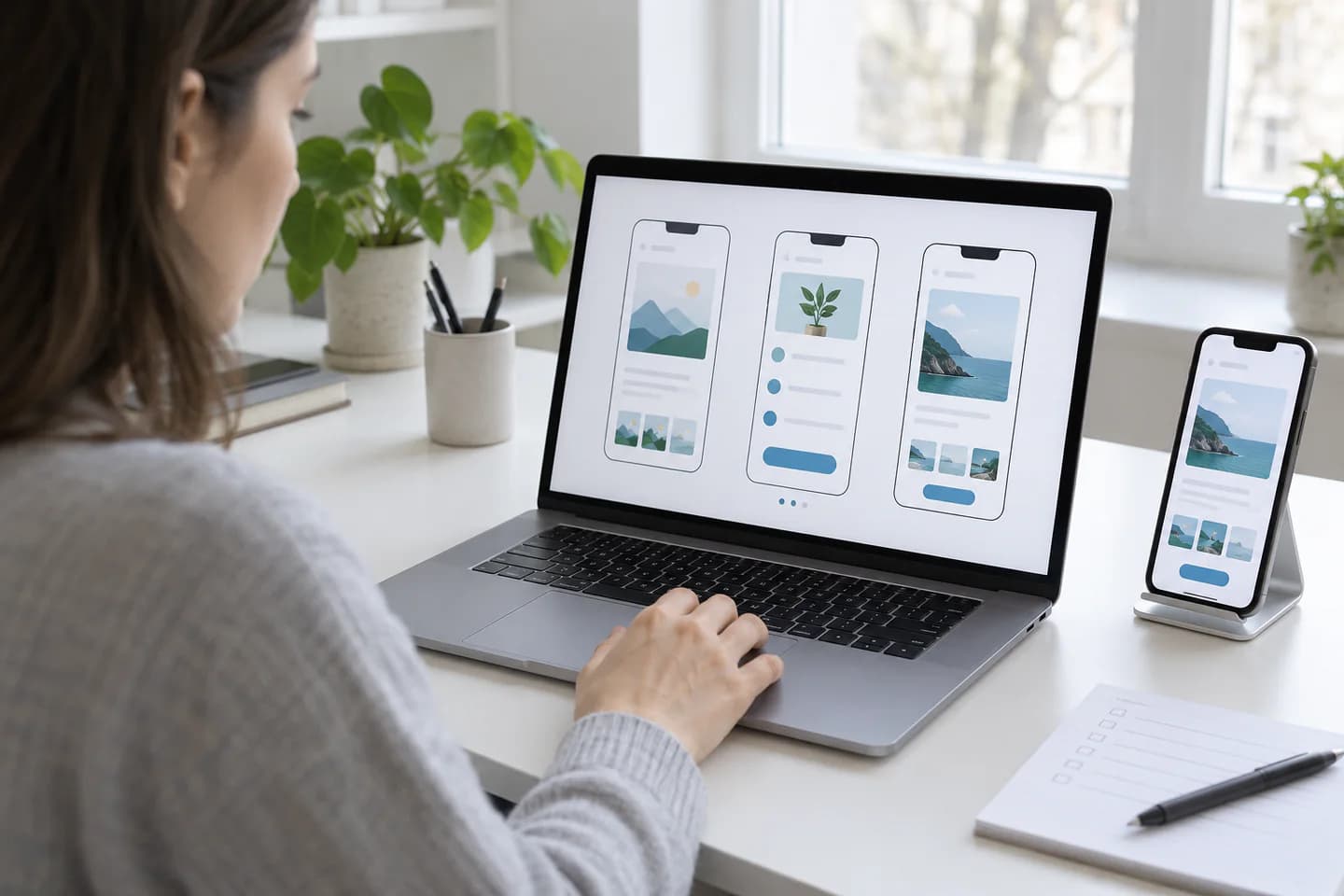
The first screenshots should explain the outcome shown in your promotion. If a creator demonstrates a shared grocery list, do not make the store page lead with an unrelated dashboard. Use real product screens and concise explanations that stay readable on a phone.
Apple's custom product pages let you create different versions of a product page and share them through distinct URLs. They can help align a campaign with a specific feature or audience. Plan those variations around genuinely different needs, and check the current platform requirements before committing your production assets.
SourceConfigure custom product pages (Apple) (opens in a new tab) ↗
04Use creators to show the app doing a real job
A creator demonstration works best when the app solves a recognizable problem in context. Let the viewer see the action, the relevant screen, and the result. Avoid asking the creator to recite a long feature list while the product remains invisible.
Choose creators whose viewers are likely to have the problem your app solves. A household organizer explaining a shared calendar can be a closer fit than a general technology account with a much larger audience. Provide a working account, accurate pricing, the current interface, and a support contact so filming does not turn into a guessing exercise.
A useful creative brief
Show how two flatmates add groceries to the same list and check items off in the shop. Make the shared-list feature visible, explain any relevant plan restriction, and finish with one clear invitation to try it.
05Test a small number of acquisition ideas properly
Start with a few specific combinations of audience and message. Separate them well enough to understand their results. If every campaign mixes markets, creative approaches, and offers, the account may generate data without giving you a useful decision.
Measure cost per install alongside cost per activated user. In an illustrative test, a campaign spending $300 for 150 installs and 15 activated users costs $2 per install and $20 per activation. Another spending $300 for 75 installs and 30 activations costs $4 per install but $10 per activation. The cheaper install is not the cheaper useful user. These figures are an example, not a benchmark.
06Help people reach value before asking for more effort
Walk through the first session on an ordinary phone and a realistic connection. Notice unclear permissions, lengthy forms, broken deep links, and steps that require knowledge a new user does not have. Explain necessary requests at the point where they make sense.
Where the product permits it, show a useful result early. Then make the next action clear. If a paid feature is central to the advertised experience, explain the cost honestly. An acquisition message that hides a necessary subscription may increase curiosity while creating disappointment immediately after installation.
07Scale around evidence of repeat use
Review groups of users acquired in the same period and through comparable channels. Look for meaningful return behavior, product activity, support issues, and commercial outcomes. Compare like with like, because a subscription app and an occasional travel utility will naturally have different patterns of use.
Increase investment when the audience, message, and product experience show a repeatable fit. Keep improving the store page and onboarding while acquisition runs. Growth becomes easier to manage when each new visitor enters a journey that has already been checked from start to finish.
Common questions
What is the best way to promote a new app?
Start with a specific audience and a clear use case. Prepare a convincing store page, test onboarding, then compare a small number of relevant channels such as creator demonstrations, useful search content, and paid acquisition. The best channel depends on the product and audience.
Can creators help increase app downloads?
They can help relevant viewers understand the product through demonstrations. Results depend on audience fit, the content, the store page, and the app itself. Use appropriate campaign links and compare installs with subsequent activation rather than assuming views equal downloads.
Is a low cost per install always good?
No. Low-cost installs can still be poor value if users never complete a meaningful action or return. Include activation, retention, and the economics of your product when assessing a campaign.
Working with GME? Read the creator FAQ for payments, cancelling and statistics.